Product
Solutions
Resources
Customers
Company

Enterprise anti-phishing software built for modern email attacks

Sublime's agentic email security platform catches credential theft, QR codes, calendar invites, callback scams, and BEC, then adapts to the attacks your organization sees.

Phishing in a nutshell

Phishing isn't one attack pattern anymore. It's a category of techniques that share a goal, getting a person to click, reply, scan, or call, and little else in how they're built.That range is what makes phishing hard to stop with one detection method. A platform tuned for link-based credential theft can still miss a QR code, a calendar invite, or a BEC email that carries no malicious payload at all, just a convincing request. Static rules and centrally maintained models fall further behind every time attackers introduce a new variant, and introducing a new variant now takes far less effort than it used to.

Why phishing keeps getting through

Most anti-phishing tools were built to catch the attacks of a few years ago. Here's what's changed.

Attacks are built for your organization, not a generic target

Nearly 90% of malicious emails are customized to their target organization, according to Sublime's Email Threat Research Report, which is why static, centrally maintained rules fall behind.

AI is accelerating how fast lures change

Signals of AI-generated phishing content jumped roughly 5x between Q1 and Q4 of 2025, per the same Email Threat Research Report, so a rule written for last quarter's lure often misses this quarter's version.

Attackers keep finding new delivery methods

QR codes and calendar invites route around filters built to scan links and text. QR code attacks grew 282.7% in the second half of 2025, and ICS phishing grew roughly 100x over the same year, per Sublime's threat research.

Broader coverage can mean more work, not less

Detecting more only helps if it doesn't flood the SOC. Coverage needs to come paired with automated triage, not just more alerts.

Phishing techniques Sublime protects against

Credential phishing

Impersonates a login page or trusted brand to harvest usernames, passwords, and MFA codes. Attackers rotate domains constantly, stand up lookalike infrastructure within hours, and build pages that are visually identical to the real thing, so a quick glance often isn't enough to catch them. Sublime checks sender authentication (SPF, DKIM, DMARC) alongside computer vision and language analysis, weighing what a message claims to be against what the infrastructure behind it actually shows, to catch impersonation that clears authentication checks on its own.

QR code phishing

Hides a malicious link inside a QR code, often in an image or PDF attachment, to route around filters built to scan visible text and links. QR codes also move the attack off a monitored device, since a person usually scans with a personal phone, outside any corporate security stack, which is part of why this technique has grown so fast. Sublime decodes embedded QR codes during analysis and evaluates the resulting destination with the same scrutiny applied to a direct link.

ICS phishing

Delivers a malicious calendar invite instead of an email, exploiting the fact that many tools don't inspect ICS attachments closely and that invites carry an implicit trust an ordinary email doesn't. A convincing invite can auto-populate a victim's calendar before anyone has scrutinized it the way they would a suspicious message. Sublime applies the same scrutiny to invite metadata, sender legitimacy, and embedded links that it applies to email body content, closing a gap many tools leave open.

Callback phishing

Uses an email with no malicious link, just a phone number and a plausible pretext like an invoice, a subscription renewal, or a fraud alert, to move the attack to a live phone call where a person is socially engineered in real time. Because the email itself carries no payload, link and attachment scanning has nothing to flag. Sublime's language models read the urgency and pretext patterns that typically precede a callback, correlated against sender history, to catch what link-only scanning would miss.

Business email compromise

Impersonates an executive, vendor, or partner to redirect a payment, change banking details, or extract sensitive data, often with no attachment or link at all, just a convincingly worded request. BEC and fraud account for nearly one in three confirmed email threats, per Sublime's Email Threat Research Report, and thread hijacking, quietly inserting a fraudulent reply into an existing conversation, is the leading technique behind it. Sublime's relationship and behavior analysis flags spoofed domains, unusual payment requests, and hijacked threads that a generic rule set would read as ordinary correspondence.

Automate busy work, focus on what matters

Sublime’s abuse mailbox automation lets analysts spend less time in triage.

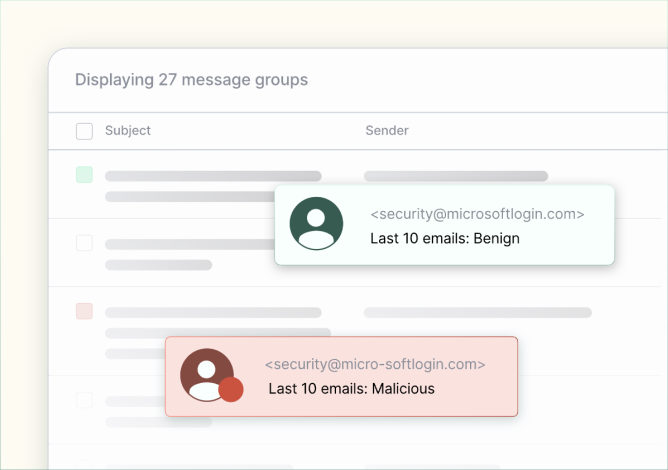
Analyze sender behavior and relationships

Every message is checked against the sender's history with your organization: domain age, prior contact, and whether the claimed relationship (vendor, executive, partner) matches what Sublime has actually observed.

Understand language and intent

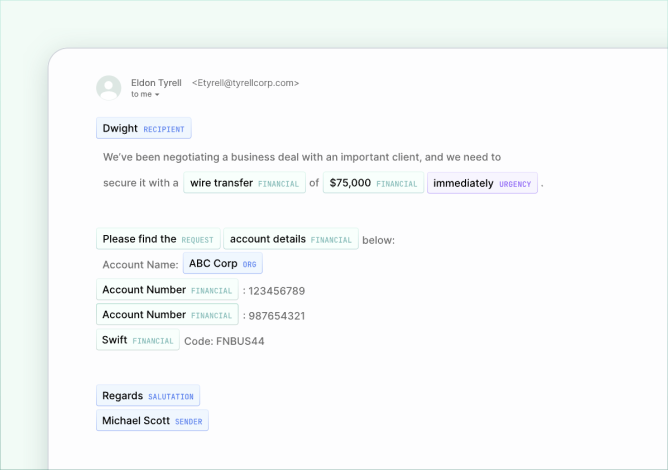
Natural language understanding reads what a message is asking the recipient to do, whether that's urgency around a wire transfer or pressure to call a number, catching BEC and callback attempts with no malicious link to scan.

Inspect links, images, QR codes, and landing pages

Computer vision decodes QR codes, evaluates visual similarity to known brands, and follows link redirects to the actual destination rather than trusting a reputation score alone.

Combine multiple signals before reaching a verdict

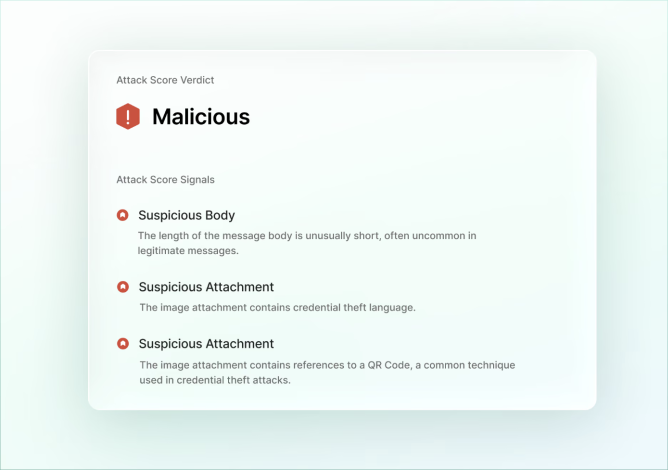
Sender behavior, language, visual analysis, and link data are weighed together before Sublime generates detection logic. Every verdict traces back to the exact signals and reasoning that produced it, so analysts can check the work.

Phishing protection that adapts to your organization

Coverage that's broad but generic still misses the attacks built specifically for your organization. Here's what adapts it.

Organization-specific detection

ADÉ (Autonomous Detection Engineer) generates new detection logic based on the attacks your organization actually sees. Coverage reflects your specific environment, not a baseline shared across every customer on the platform.

Nuanced industry expertise

Phishing tactics vary by sector: more BEC and wire-fraud attempts in financial services, more credential phishing aimed at SSO in SaaS, higher-volume low-sophistication attacks in education. Sublime tailors detection and reporting accordingly.

Transparent detection logic

Every verdict is auditable. Analysts see the exact signals and detection logic behind a decision, not a plausible explanation generated after the fact.

Autonomous detection engineering

When Sublime's agents encounter a new phishing pattern, ADÉ authors and backtests new detection logic against historical traffic before it ever reaches production, so new coverage doesn't come at the cost of new false positives.

Inbound email security features

Sublime offers a wide range of features to detect and prevent email attacks.

API

Build custom workflows and integrations with comprehensive API access.

Attack grouping

Automatically cluster related attacks to understand threat patterns and accelerate response.

Bulk triage operations

Process multiple flagged messages simultaneously based on Rule matches.

Custom rule creation

Build tailored detection logic for your organization's specific risk profile.

Dashboards

Monitor security posture with customizable reporting and threat visibility.

Email infrastructure analysis

Analyze sending patterns, authentication failures, and hosting providers.

Quarantine

Safely isolate suspicious messages with one-click remediation and release capabilities.

SIEM/SOAR

Integrate seamlessly with existing security orchestration and response tools.

What our customers are saying

The black box approach to email security no longer works. 
It reduces visibility on how 
Brex may be attacked and 
the tactics and techniques 
used by attackers. 


With Sublime, we now have transparency and the confidence to keep up with emerging threats.

Alex Carter

Mark Hillick

CISO, Brex

The ability to automate remediations with high confidence and minimize manual reviews unlocks a new level of efficiency in our SOC. It’s hard to imagine going back to life before Sublime.

JJ Agha

JJ Agha

CISO, Fanduel

What I love about the platform is that it just works. I’m so tired of all these tools I have to futz with, and Sublime is just easy.

Jason Kikta

Jason Kikta

CISO, Automox

With Sublime, we no longer wait weeks for vendor updates. Our team reacts instantly - which is critical for our fast-moving environment.

User Profile

Ronald Richards

OVO Energy

Latest from Sublime

Ready to transform your abuse mailbox with AI email security?

See how Sublime's intelligent email security platform can reduce MTTR and automate your abuse mailbox workflows.

Frequently asked questions

Can AI based email security integrate with existing security tools?

Yes, Sublime's intelligent email security platform offers robust APIs and webhooks for seamless integration with SIEMs, SOAR platforms, and other security tools in your existing stack.

How does automated email security improve SOC efficiency?

Automated email security reduces manual triage time by up to 90%, allowing SOC teams to focus on strategic initiatives while the AI handles routine abuse mailbox tasks with consistent accuracy.

How quickly can AI email security software be deployed?

Most organizations can deploy Sublime within days. Cloud-based deployment enables rapid implementation with minimal infrastructure changes required for immediate threat protection.

What is AI email security and how does it work?

Sublime’s agentic email security deploys a team of specialized AI agents – like an analyst and a detection engineer – that work together to protect, triage, and adapt your defenses in real time.

What makes machine learning email security more effective than traditional methods?

Machine learning email security adapts to new threats in real-time, learns from analyst decisions, and processes vast amounts of data to identify subtle attack patterns that rule-based systems might miss.

Now is the time

See how Sublime delivers autonomous protection by default, with control on demand.